(719) 434-3919 [email protected]

Reverse Mortgage Institute - Colorado Reverse Mortgages

  • Home
  • Reverse Mortgage Facts
    • NRMLA Fact vs Fiction
    • Reverse Mortgages 101
    • About RMs
    • RMs in Detail
    • FAQ
    • Fact or Fiction
    • Reverse Mortgage Blog
  • RM Stories
    • Scenarios
    • Local Success Stories
    • National success stories
  • RM Uses
    • 25 Ways to Use Your RM
    • Long Term Care (LTC)
    • 8 RM Myths
  • RM Videos
  • Reverse Mortgage Blog
  • Senior Protections
    • Senior Safeguards
    • NRMLA Code of Ethics
  • Our Team
  • Ask a Mortgage Expert
  • Review Me
  • Testimonials
  • Contact Us
    • Ask an Expert

February 22, 2017 by jazzsocialmedia

Colorado Springs Reverse Mortgages General Information

Colorado Springs Reverse Mortgages General Information

Colorado Springs Reverse Mortgages General Information

What is a reverse mortgage?

Colorado Springs Reverse Mortgages General Information: A Colorado reverse mortgage is a federally regulated program for homeowners, aged 62 and older. It allows the equity in your home to pay you rather than you paying for the home.

What is a Government Insured HECM program?

HECM stands for Home Equity Conversion Mortgage. It is a federally insured and guaranteed program. The HECM is a safe way for you to access the equity in your home without ever making a mortgage payment.

How is this program safe for senior homeowners?

No matter what happens in the economy, how much money you receive, or how long you live in your home you will never be required to make a mortgage payment. In addition, no matter what happens to your lender or your home’s value you have guaranteed access to your money.

Who owns the home if I take a reverse mortgage?

You own the home. However, you pledge the home as collateral.

What happens if, in the future, the loan exceeds the value of the home?

Your reverse mortgage will continue - thanks to the federal insurance. The line of credit will still be available and monthly disbursements you may have set up will still be sent to you.

How are reverse mortgages different today?

Today’s reverse mortgages are highly regulated by Steve and Federal laws to make then safe and to protect you. Among others, the following regulations apply:

  • You retain title of the home.
  • No equity share is allowed, meaning the lender does not slowly take over your home.
  • Fees and costs are federally regulated.

How does a reverse mortgage compare to a conventional mortgage?

IN a conventional forward mortgage, you make monthly payments to the bank, eventually paying off the mortgage over time. With a reverse mortgage, you receive cash from your lender, as lump sum upfront, as monthly installments or as a line of credit that grows over time. As long as you live in your home, you never have to pay off a single dollar of the loan.

What restrictions apply to the cash I receive from a reverse mortgage?

It is your money and you can use it the way you want. It is non-taxable, and does not affect social security payments. We recommend that you talk with a competent financial advisor to determine the effect on any other benefits you may be receiving.

When does a reverse mortgage become due, and what happens then?

When you no longer live in your home, or when you pass away, the reverse mortgage becomes due. You or your heirs have two options:

  1. Pay off the reverse mortgage, including the accrued interest and retain ownership.
  2. Give up ownership of the home and receive the difference between the net sales proceeds and the loan balance. You will not be liable for any shortfall if the sales proceeds do not cover the loan.

Your loan may also become due and payable if you do not continue meeting the terms of the loan. (For example, paying taxes and insurance owed on the property.)

Read more at: http://www.reversevision.com
 

Filed Under: Blog, Colorado Reverse Mortgages Tagged With: Colorado Reverse Mortgages, Colorado Springs reverse mortgage, Denver Reverse Mortgages, Fort Collins Reverse Mortgage, Provident Lending, Steve Haney

February 20, 2017 by jazzsocialmedia

Reverse Mortgage Self-Evaluation: A Checklist of Key Considerations

Reverse Mortgage Self-Evaluation: A Checklist of Key Considerations

Reverse Mortgage Self-Evaluation

Reverse Mortgage Self-Evaluation: Reverse mortgages are a versatile financial tool that nearly a million homeowners have used to age-in place, and for other reasons. However, like any financial product, reverse mortgages should be considered carefully before deciding whether to obtain one.

Reverse Mortgage Self-Evaluation
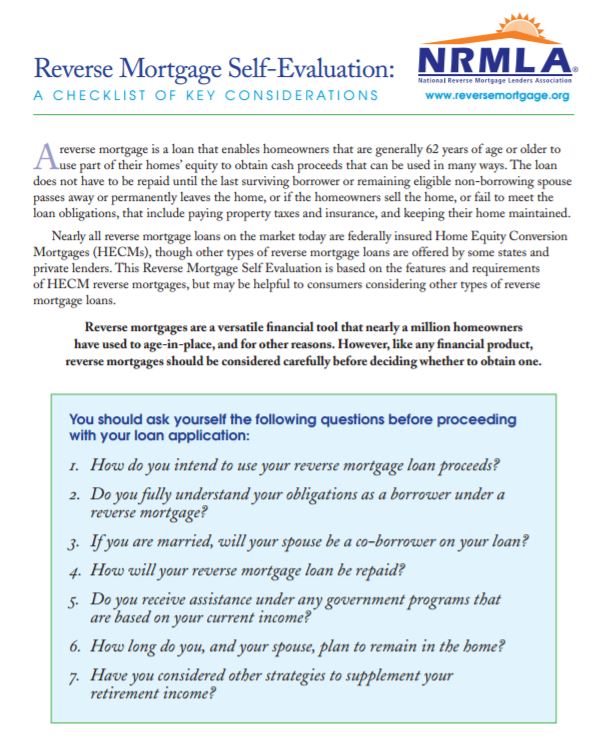
Reverse Mortgage Self-EvaluationThe National Reverse Mortgage Lenders Association’s free Reverse Mortgage Self-Evaluation poses seven questions and important considerations interested consumers should ask themselves, and think about, before proceeding with a loan application.

The six-page Reverse Mortgage Self-Evaluation: A Checklist of Key Considerations was created to help senior homeowners consider whether a reverse mortgage is right for them. This guide is best shared during the pre-application phase so that consumers can discuss any questions with their HUD-approved reverse mortgage counselor.

The Self-Evaluation is also posted on NRMLA’s consumer education website at www.reversemortgage.org/Checklist.

The seven questions below, plus additional considerations and information about reverse mortgage loans, are included in NRMLA’s Reverse Mortgage Self-Evaluation.Download and print a free copy of the Checklist here.

1. How do you intend to use your reverse mortgage loan proceeds?

One of the advantages of a reverse mortgage loan is that borrowers generally have the freedom to use their cash proceeds any way they choose. Eligible homeowners obtain reverse mortgages for many reasons.

Reverse mortgage loans are most successful when borrowers have a plan to ensure the money supports and sustains them for as long as they want to stay in their home. Additional consumer protections were put into place in 2013 to help borrowers preserve more of their home equity during the first year of the loan.

  • Do you have a plan for making your reverse mortgage loan proceeds last?

2. Do you fully understand your obligations as a borrower under a reverse mortgage?
Reverse mortgage borrowers are not required to make monthly loan payments to their lender, but must continue to meet certain obligations in order to stay current on the loan. Failure to meet these obligations may result in the loan becoming due and payable.

  • Will you live in your home for the majority of the calendar year?
  • Are you prepared to maintain the condition of your property?
  • Will you be able to pay your property taxes, insurance, and homeowner fees?
  • Do you understand what will happen if you cannot pay your taxes, insurance, or homeowner fees?
  • Do you understand your personal finances will be reviewed?

3. If you are married, will your spouse be a co-borrower on your loan?
Under the rules of a HECM reverse mortgage, borrowers must be at least 62 years old, named on the title of the home, and use the home as their principal residence. Spouses who do not meet these criteria cannot sign the HECM reverse mortgage loan documents as a borrower and will be identified as either an eligible non-borrowing spouse or an ineligible non-borrowing spouse depending on certain additional criteria. You should speak to your HUD-approved reverse mortgage counselor about the non-borrowing spouse criteria.   

  • What if your co-borrower spouse survives you?
  • What if your eligible non-borrowing spouse survives you?
  • What if your ineligible non-borrowing spouse survives you?

4. How will your reverse mortgage loan be repaid?
A reverse mortgage is a non-recourse loan which means that the borrower or the borrower’s estate will never be obligated to pay the lender more than the loan balance or the current value of the home, whichever is less. When a loan is called due and payable, the reverse mortgage borrower or the borrower’s estate only needs to repay the lesser of either the loan balance or 95% of the home’s appraised value at that time. 

  • Do you know your options for repaying the loan?
  • Do you want someone to inherit your home after you pass away?
  • Did you know that you can prepay your reverse mortgage loan?

5. Do you receive assistance under any government programs that are based on your current income? 
A reverse mortgage does not affect regular Social Security or Medicare benefits. However, if you are on Medicaid or receive Supplemental Security Income (SSI), reverse mortgage proceeds may affect your benefits.

  • Are you considering a lump sum cash draw?

6. How long do you, and your spouse, plan to remain in the home?
Reverse mortgages, like many financial products, have costs associated with them, including some that need to be paid up-front when the reverse mortgage is obtained. Among other things, that means that if you or your spouse are not likely to continue to live in your home for more than several years after the reverse mortgage is obtained, you should pay particular attention to those costs and consider them carefully with your HUD-approved reverse mortgage counselor and whether there may be other more cost effective alternative strategies.

7. Have you considered other strategies to supplement your retirement income?

  • Do you qualify for public or private benefits available to low-income people with Medicare?
  • Did you know there are other ways to tap your home equity?

Filed Under: Blog, Colorado Reverse Mortgages Tagged With: Colorado Springs reverse mortgage, Denver Reverse Mortgages, good Fort Collins reverse mortgage, Provident Lending, Pueblo Reverse Mortgage, Steve Haney

February 8, 2017 by jazzsocialmedia

Colorado Reverse Mortgage Checklist

Colorado Reverse Mortgage Checklist

Colorado Reverse Mortgage Checklist

Thinking about a reverse mortgage, but don’t know if you qualify? If you want to size up whether a reverse mortgage is right for you before you talk to Steve about starting the reverse mortgage process, here is a Colorado reverse mortgage checklist for you, so you can see if you may qualify. But remember-Steve is a professional, so even if you think you may not qualify, talk to him by calling (719) 434-3919. He knows many ways to put you in a better financial situation. That’s why they call him The Mortgage Doctor!

Click here or on the picture above to download a free copy of the Colorado reverse mortgage checklist to your computer.

1. How do you intend to use your reverse mortgage loan proceeds?

One of the advantages of a reverse mortgage loan is that borrowers generally have the freedom to use their cash proceeds any way they choose. Eligible homeowners obtain reverse mortgages for many reasons.

Reverse mortgage loans are most successful when borrowers have a plan to ensure the money supports and sustains them for as long as they want to stay in their home. Additional consumer protections were put into place in 2013 to help borrowers preserve more of their home equity during the first year of the loan.

  • Do you have a plan for making your reverse mortgage loan proceeds last?

2. Do you fully understand your obligations as a borrower under a reverse mortgage?
Reverse mortgage borrowers are not required to make monthly loan payments to their lender, but must continue to meet certain obligations in order to stay current on the loan. Failure to meet these obligations may result in the loan becoming due and payable.

  • Will you live in your home for the majority of the calendar year?
  • Are you prepared to maintain the condition of your property?
  • Will you be able to pay your property taxes, insurance, and homeowner fees?
  • Do you understand what will happen if you cannot pay your taxes, insurance, or homeowner fees?
  • Do you understand your personal finances will be reviewed?

3. If you are married, will your spouse be a co-borrower on your loan?
Under the rules of a HECM reverse mortgage, borrowers must be at least 62 years old, named on the title of the home, and use the home as their principal residence. Spouses who do not meet these criteria cannot sign the HECM reverse mortgage loan documents as a borrower and will be identified as either an eligible non-borrowing spouse or an ineligible non-borrowing spouse depending on certain additional criteria. You should speak to your HUD-approved reverse mortgage counselor about the non-borrowing spouse criteria.   

  • What if your co-borrower spouse survives you?
  • What if your eligible non-borrowing spouse survives you?
  • What if your ineligible non-borrowing spouse survives you?

4. How will your reverse mortgage loan be repaid?
A reverse mortgage is a non-recourse loan which means that the borrower or the borrower’s estate will never be obligated to pay the lender more than the loan balance or the current value of the home, whichever is less. When a loan is called due and payable, the reverse mortgage borrower or the borrower’s estate only needs to repay the lesser of either the loan balance or 95% of the home’s appraised value at that time. 

  • Do you know your options for repaying the loan?
  • Do you want someone to inherit your home after you pass away?
  • Did you know that you can prepay your reverse mortgage loan?

5. Do you receive assistance under any government programs that are based on your current income? 
A reverse mortgage does not affect regular Social Security or Medicare benefits. However, if you are on Medicaid or receive Supplemental Security Income (SSI), reverse mortgage proceeds may affect your benefits.

  • Are you considering a lump sum cash draw?

6. How long do you, and your spouse, plan to remain in the home?
Reverse mortgages, like many financial products, have costs associated with them, including some that need to be paid up-front when the reverse mortgage is obtained. Among other things, that means that if you or your spouse are not likely to continue to live in your home for more than several years after the reverse mortgage is obtained, you should pay particular attention to those costs and consider them carefully with your HUD-approved reverse mortgage counselor and whether there may be other more cost effective alternative strategies.

7. Have you considered other strategies to supplement your retirement income?

  • Do you qualify for public or private benefits available to low-income people with Medicare?
  • Did you know there are other ways to tap your home equity?

Filed Under: Blog, Colorado Reverse Mortgages Tagged With: Colorado reverse mortgage, Colorado Springs reverse mortgage, Provident Lending

June 27, 2016 by jazzsocialmedia

NBC Nightly News: Reverse Mortgage is Smart Money

NBC Nightly News: Reverse Mortgage is Smart Money

Reverse Mortgage is Smart MoneyIN THE PRESS: Reverse Mortgage is Smart Money?

An NBC Nightly News segment on reverse mortgages aired April 22nd, saying:

“Consumer advocates now say that taking out a reverse mortgage could be a smart way to bring in more money.”

The piece emphasizes new consumer protections for borrowers and includes an interview with Greg McBride of bankrate.com, who said:

“Reverse mortgages are going to be a lifeline for millions of retirees who are under-saved for retirement.”

Filed Under: Blog, Colorado Reverse Mortgages

May 18, 2016 by jazzsocialmedia

New Reverse Mortgage Consumer Protections

New Reverse Mortgage Consumer Protections

New Reverse Mortgage Consumer Protections
“As we grow older as a nation, we have a responsibility to ensure reverse mortgages remain a safe, secure and sustainable financial option for future generations of senior homeowners,” said Edward Golding.

The Department of Housing and Urban Development issued a proposal Wednesday to codify recent changes to its reverse mortgage program and to provide new reverse mortgage consumer protections for seniors, including a cap on annual interest rate increases.

In National Mortgage News, Brian Collins recently said:

The Department of Housing and Urban Development issued a proposal Wednesday to codify recent changes to its reverse mortgage program and to provide additional protections for seniors, including a cap on annual interest rate increases.

“We’ve gone to great lengths to protect seniors and ensure they can remain in their homes where they’ve raised families and where they hope to live out their days,” said Edward Golding, principal deputy assistant secretary for housing at HUD.

The Federal Housing Administration has revamped its Home Equity Conversion Mortgage program over the past two years to tighten up the reverse mortgage program and require financial assessments for the first time to ensure borrowers have the financial wherewithal to remain in their home and pay for property taxes and homeowners insurance.

Now, FHA wants to add additional consumer protections, according to Golding.

“As we grow older as a nation, we have a responsibility to ensure reverse mortgages remain a safe, secure and sustainable financial option for future generations of senior homeowners,” he said.

The proposed changes would:

• Make certain that required HECM counseling occurs before a mortgage contract is signed.

• Require lenders to fully disclose all loan features

• Cap interest rate increases on HECM adjustable rate mortgages so lifetime increases or decreases cannot exceed 5 percentage points.

• Reduce the cap on annual interest rate increases on HECM adjustable rate mortgages from 2% to 1%.

• Require lenders to pay mortgage insurance premiums until the HECM is paid in full, foreclosed on, or a deed-in-lieu is executed rather than until when the mortgage contract is terminated.

• Define “property charges” to include utilities when it is borrower’s responsibility to pay the bill.

• Include utility payments in the property charge assessment.

• Create a “cash for keys” program to encourage borrowers to complete a deed-in-lieu transaction and gracefully exit the property versus enduring a lengthy foreclosure process.

The proposal is being issued for 60-day comment period.

To read this article on National Mortgage News, click here.

Filed Under: Blog, Colorado Reverse Mortgages

April 29, 2016 by jazzsocialmedia

Reverse Mortgages can Increase Retirement Income

Reverse Mortgages can Increase Retirement Income

The holy grail for retirement income is improved efficiency: spend more while saving more. Reverse mortgages can increase retirement income, allowing both saving and spending.

Originally published at Forbes. In the article, Dr. Wade Pfau, Phd, CFA says:

Maintaining higher fixed costs in retirement increases exposure to sequence risk by requiring a higher withdrawal rate from remaining assets. Drawing from a reverse mortgage has the potential to mitigate this aspect of sequence risk by reducing the need for portfolio withdrawals at inopportune times.

An HECM line of credit provides a tool that can be used to mitigate the impacts of sequence of returns risk. Since 2012, this has been the focus of a series of research articles highlighting how the strategic use of a reverse mortgage can either preserve greater overall legacy wealth for a given spending goal, or can otherwise sustain a higher spending amount for longer in retirement.

The holy grail for retirement income strategies is improved efficiency: being able to spend more while preserving a larger legacy. The synergies created by strategic use of an HECM line of credit can support a higher spending level in retirement and/or support a greater legacy value for remaining assets.

The conventional wisdom on how to treat housing wealth in retirement was to preserve it as a last resort option. If it did not need to be used, the home may be left as part of the legacy for the next generation.

However, starting in 2012, a series of articles published in the Journal of Financial Planning investigated how obtaining an HECM reverse mortgage early in retirement and then strategically spending from the available credit can help improve the sustainability of retirement income strategies.

We can think of legacy value at death as the combined value of any remaining financial assets plus the remaining home equity once the reverse mortgage loan balance has been repaid:

Legacy Wealth = Remaining Financial Assets + [Home Equity – minimum(Loan Balance, 95% of Appraised Home Value)]

If we do not worry about the percentage breakdown between these two categories, research reveals the possibility of sustaining a spending goal while also leaving a larger legacy at death. Strategically using home equity can lead to a more efficient strategy than the less flexible option of viewing the home as the legacy asset that must not be touched until everything else is gone. This analysis provides a way to test whether the costs of the reverse mortgage—in terms of the upfront costs and compounding growth of the loan balance—are outweighed by the benefits of mitigating sequence risk. Strategic use of a reverse mortgage line of credit is shown to improve retirement sustainability, despite the costs, without adversely impacting legacy wealth.

Based on his personal research going as far back as 2004, Barry Sacks got the ball rolling and received widespread recognition for ideas presented in a research article he published with his brother Stephen in the February 2012 issue of the Journal of Financial Planning. William Bengen is to the 4% rule what Barry Sacks is to supplementing retirement income with a reverse mortgage line of credit. He was thinking over a decade ago about how one could use housing wealth as a type of volatility buffer to help mitigate sequence of returns risk.

The aptly named article these brothers wrote—“Reversing the Conventional Wisdom: Using Home Equity to Supplement Retirement Income”—set out to present the reverse mortgage option as something more than a last resort.

The title states their objective clearly. They investigated sustainable withdrawal rates from an investment portfolio coupled with home equity, and determined whether asset depletion takes place when using three different strategies for incorporating home equity into the retirement income plan:

  1. Use a reverse mortgage as a last resort to continue spending only after the investment portfolio is depleted (i.e., the conventional wisdom).
  2. Open a reverse mortgage line of credit at the start of retirement and spend it down first, then transition to using portfolio withdrawals for the remainder of retirement.
  3. Open a reverse mortgage line of credit at the start of retirement and draw from it during any years that follow a negative return for the investment portfolio. This is their “coordinated strategy.”

They reversed the conventional wisdom by using Monte Carlo simulations to quantify how spending strategies (2) and (3) enjoyed a higher probability for success and could be sustained longer than (1).

They also found the remaining net worth of the household (the value of their remaining financial portfolio plus any remaining home equity) after thirty years of retirement is twice as likely to be larger with an alternative strategy than with the conventional wisdom of saving home equity to be used last.

For withdrawal rate goals of between 4.5% and 7% of the initial retirement date portfolio balance, the residual net worth after thirty years was 67% to 75% more likely to be higher with a coordinated strategy than with a strategy using the reverse mortgage as a last resort. In other words, spending home equity did not ruin the possibility for leaving an inheritance. Instead, the opposite was true.

How is this the case? Essentially, scenarios (2) and (3) provide a cushion against the dreaded sequence of returns risk that is such a fundamental challenge to building a sustainable retirement plan. When home equity is used last, retirees are spending down their volatile investment portfolio earlier in retirement and are more exposed to locking in portfolio losses, more easily leading them on the path to depletion.

With option (2), if home equity is spent first, the financial portfolio is left alone in the interim, providing a better chance to grow so that by the time home equity is spent, retirees will be able to continue a given spending amount in their retirement using what is likely be a lower withdrawal rate from a now larger portfolio. They quantify that the costs and interest paid on the reverse mortgage, while substantial, are less than the benefits the strategy provides to retirees and their beneficiaries.

And option (3) provides a more sophisticated technique to grapple with sequence of returns risk by only spending from the reverse mortgage line of credit when the retiree is vulnerable to locking in portfolio losses. That is, spend from the line of credit after years in which the financial portfolio has declined.

Sacks and Sacks make clear that their point is not that all retirees should take a reverse mortgage, but that retirees who wish to remain in their homes for as long as possible should view it as more than a last resort. If a retiree decides to spend at a higher level, which could lead to portfolio depletion and then possibly require them to also generate cash flows from their home equity, there is indeed a better way.

To read the original article on retirementresearcher.com, click here.

Filed Under: Blog, Colorado Reverse Mortgages, Retirement Plans

March 25, 2016 by jazzsocialmedia

NRMLA Blog Squad Called Into Action

NRMLA Blog Squad Called Into Action

The NRMLA blog squad called into action this week when CNBC published an article, entitled Is A Reverse Mortgage Right for You?, that shows how lower interest rates can lead to larger loan amounts for reverse mortgage borrowers. While the article itself was neutral, it generated many negative and misinformed comments, prompting NRMLA’s Director of Public Affairs, Jenny, Werwa, to invite members of the NRMLA Blog Squad to submit comments that sought to educate and refute bad information.

Beth Paterson, CRMP, of Greenleaf Financial, LLC, wrote: “Just as with any mortgage of financial product, or any purchase for that matter, one should get educated about the reverse mortgage, and work with a loan officer that are comfortable with and doesn’t pressure them. If possible, find someone who is local and will meet with you face-to-face. Members of the NRMLA adhere to a strict code of conduct.”

NRMLA Blog Squad Called into ActionSteve Haney, The Mortgage Doctor, is a member of the NRMLA (National Reverse Mortgage Lenders Association), has won awards for his work, and is trusted throughout Colorado Springs as a fair and informative loan officer. Contact him today!

Filed Under: Blog, Colorado Reverse Mortgages

March 22, 2016 by jazzsocialmedia

WSJ: New math on reverse mortgages

New math on reverse mortgages

Advisers now are promoting them as a valuable tool for retirement planning, thanks to recent safeguards

new math on reverse mortgagesYesterday in the Wall Street Journal, Robert Powell discusses how he sees the new reverse mortgage as a valuable tool for retirees.

“The reverse mortgage has won some new respect.

A decade ago, most financial advisers would roll their eyes at the mention of reverse mortgages, loans that give homeowners an advance on their home equity and allow them to delay repayment until the home is sold. Such products, these advisers used to say, weren’t for their clients, but rather for those who didn’t prepare financially for retirement. But new safeguards in recent years have changed this.”

Read the entire article by clicking here.

Filed Under: Blog, Colorado Reverse Mortgages

March 21, 2016 by jazzsocialmedia

5 ways a reverse mortgage can help retirees

5 ways a reverse mortgage can help retirees

5 ways a reverse mortgage can help retirees is taken from an article written by Jack M. Guttentag, Professor of Finance Emeritus at the Wharton School of the University of Pennsylvania

5 ways a reverse mortgage can help retirees

Use a reverse mortgage to pay off an existing mortgage

Many homeowners today choose to retire, or are obliged to, before they have fully paid off their mortgage. With their income reduced, the required monthly mortgage payment can become heavily burdensome.

If the balance is not too large relative to the value of the home, it can be paid off with the proceeds of a reverse mortgage, which has no required payment. If the borrower is 62, the balance of the old mortgage can’t exceed 50% of the value of the home; the cutoff rises to about 68% for a borrower of 87.

5 ways a reverse mortgage can help retirees

Use a Reverse Mortgage Monthly Payment to Delay Taking Social Security

For most seniors, waiting until age 70 before collecting social security, as opposed to taking a smaller amount earlier, is an excellent investment. A typical senior who could draw $1350 a month at age 62, would see the draw increase to $2376 at age 70. Yet more than 2 of every 3 workers eligible for social security take it early. One major reason is that they are short of income. This can be remedied if they are homeowners with equity.

Not that much equity is needed. If the borrower is 62, a monthly payment of $1,000 covering the 8 years until age 70 is available with equity of $155,000. At age 67, when the payment term is only 3 years, the required equity is only $66,000. If the borrower has more equity than is needed, all the better, it can be drawn on to meet other needs as they arise.

5 ways a reverse mortgage can help retirees

Increase Monthly Income During Lifetime in House

The most straightforward remedy for inadequate income is what is called a “tenure” payment, which is a monthly payment that runs as long as the borrower resides in the house. The payment varies with the property value, the borrower’s age, and interest rates when the mortgage is taken out. On March 11, 2016, the tenure payment ranged from $266 for a borrower of 62 with a house worth $100,000, to $2582 for a borrower of 87 with a house worth $400,000.

5 ways a reverse mortgage can help retirees

Accumulate a Financial Reserve as Protection Against the Risk of Outliving Your Money

Seniors who accumulate a nest-egg during their working years which they then use to maintain their lifestyle during retirement may be at risk of running out of money if they live too long. Even if the probability of that happening is low, no one wants to live with a low probability of becoming destitute. Seniors who own homes, however, have a way to insure against that outcome. If they take a reverse mortgage credit line and let it sit unused, the line grows over time - the longer they live in their house, the larger will be their unused line.

For example, a senior of 62 with a house worth $200,000 qualifies for an initial reverse mortgage credit line of $48,000. If interest rates remain stable, the line will grow to $157,000 in 20 years. If interest rates increase and the borrower selected a mortgage with a 5% adjustment cap, the line in 20 years would be $355,000. If the borrower had selected an ARM with a 10% adjustment cap, and rates increase by the maximum allowed, the line after 20 years would be $752,000.

5 ways a reverse mortgage can help retirees

Downsize by Purchasing a House Using a Reverse Mortgage to Minimize Asset Liquidation

Many home purchasers are seniors who already own homes but want a change. They may want a house in a different location, and in many cases they want to downsize both the physical house and the financial burdens that come with it. A HECM reverse mortgage can facilitate this process by funding part of the cost, which reduces the need to liquidate other assets without imposing a monthly payment obligation.

For example, a senior of 62 purchasing a $200,000 home could obtain up to $98,375 with a HECM. This reduces the amount that must be obtained from asset liquidation and other sources to $101,625. A purchaser of 82 could obtain up to $128,375 with a HECM, reducing asset liquidation to $71,625.

To read this article in full on the Huffington Post, click here.

Filed Under: Blog, Colorado Reverse Mortgages, Retirement Plans

March 18, 2016 by jazzsocialmedia

Reverse Mortgages can help pay for Long Term Care (LTC)

Reverse Mortgages can help pay for Long Term Care (LTC)

You might have sticker shock if you’re in the market for long-term care insurance. Here are seven alternatives to consider.

Long-Term Care Insurance PolicyMany long-term care insurance customers in Pennsylvania got a shock when their renewal notices arrived this year. Premiums were increasing by as much as 130 percent, and annual rates are on track to reportedly exceed $8,000 for some policies.

The increases have spurred outrage from policyholders and an inquiry by the Pennsylvania Insurance Department. Those familiar with the long-term care industry say the problem isn’t isolated to Pennsylvania and dramatically increasing rates may be expected nationwide in the years to come.

Factors pushing insurance rates higher

There are a number of factors contributing to the explosive growth in long-term care insurance premiums. “When [long-term care insurance] came out in the 80s and 90s, it was priced wrong,” says Larry Rosenthal, a certified financial planner and president of Rosenthal Wealth Management Group in Manassas, Virginia. Carriers assumed people would drop policies as they got older. However, that didn’t happen in many cases. What’s more, people are living longer and aren’t necessarily living healthier. As a result, Rosenthal says many insurance companies have fled the market and those that remain have increased premiums significantly to keep up with costs.

Compounding the problem is the fact that many people wait too long before buying a policy. “No one buys it at a young enough age for it to be inexpensive,” says Kevin Boyles, vice president of retirement and college-savings-services provider Ascensus. The ideal time to start planning is between 52 and 64, according to the American Association of Long-Term Care Insurance. Those who wait longer face higher premiums and an increased possibility of being denied coverage.

People are often confused about how to pay for long-term care. “Resources they think exist don’t exist,” says Laura Troyani who founded the website PlanBeyond.com. Most notably, many seniors expect Medicare will cover costs when, in fact, the program does not pay for ongoing long-term care. While Medicare isn’t an option, here are seven alternatives that are.

Home equity - Reverse Mortgages

Retirees without significant investments may still own a valuable asset: their house. Tapping into home equity through a line of credit, taking out a reverse mortgage or selling a house outright are some of the ways people can use their property to pay for long-term care. Click here to read more about using reverse mortgage to fund Long Term Care (LTC).

Short-term care insurance

These plans are similar to long-term care insurance policies, but benefits are typically capped at one year. Not only are they less expensive, but they may also be available to older seniors or those who aren’t otherwise eligible for long-term coverage.

Life/long-term care insurance

Rosenthal is a fan of combining long-term care coverage with life insurance. Specialty policies, often known as life-LTC hybrids, feature fixed premiums that help consumers avoid the type of rate increases currently being experienced in Pennsylvania.

Long-term care annuities

Troyani says long-term care annuities are a frequently overlooked option for covering home health, assisted living and nursing home care costs. These annuities require a hefty upfront payment, but if you need long-term care, your overall cost may be lower than what you’d spend on insurance premiums. However, don’t expect much in the way of interest. “If you’re looking at it from an investment standpoint, it’s not so awesome,” Troyani says.

Health savings accounts

For those who have an eligible high-deductible health insurance plan, a health savings account offers a way to put money aside tax-free for medical costs, such as long-term care. Boyles calls them health IRAs and notes that those who have long-term care insurance can pay their premiums with money from a HSA.

Pensions or Social Security

Depending on the size of your monthly payments and the amount of care you need, paying for services monthly out of a pension or Social Security benefit may be option.

Medicaid

When all other options have been exhausted and a person’s income and assets have been depleted, the government will step in to pay for care. Medicaid won’t pay for assisted living, but it will cover nursing home care and many states also pay for home health care services for eligible people. However, states are required by the federal government to recover the cost of long-term care from estates whenever possible. That means, for example, if a parent’s home is sold after his or her death, the proceeds could go to the state instead of heirs.

Relying on family for long-term care is the one option most experts don’t recommend. “It looks free, but there are huge, huge tolls,” Troyani says. Caregiving can be physically and financially draining, and it may lead to resentment and broken relationships within a family.

Long-term care insurance is expensive, but it’s not the only way to pay for elder care services. Weigh your options to find the right solution for your family, but don’t wait too long. The earlier you start saving, the more secure you’ll be later in life.

To read the original article on USNews.com, click here.

Filed Under: Blog, Colorado Reverse Mortgages, Long-term Care

March 12, 2016 by jazzsocialmedia

HECM Program is Working

HECM Program is Working

The HCEM program is working! A new study of HECM borrowers shows that homeowners who got reverse mortgages were generally current on property taxes, had a higher overall sense of well-being, and were satisfied with their decision.

The key findings come from “Aging in Place: Analyzing the Use of Reverse Mortgages,” a comprehensive research effort led by Dr. Stephanie Moulton, a professor at Ohio State’s John Glenn School of Public Affairs. A first look at study outcomes are published in the March-April issue of Reverse Mortgage magazine.

The outcomes, both data-supported and anecdotal, confirm that the HECM program has fulfilled its intent and improved the lives of utilizers. Read the complete article and link to the study at NRMLAonline.org.

Filed Under: Blog, Colorado Reverse Mortgages Tagged With: HECM Program is Working

February 25, 2016 by jazzsocialmedia

New Case for Reverse Mortgages

New Case for Reverse Mortgages

New Case for Reverse Mortgages
STEVE HEAP/ISTOCK

A recent Wall Street Journal article is encouraging seniors to make reverse mortgage a part of their retirement plans. He says the is no a new case for reverse mortgages.

Dr. Wade Pfau says:

Reverse mortgages provide the ability to borrow a portion of your home equity without being required to repay the loan until the owner has permanently left it. The idea for reverse mortgages is that the value of your home is eventually used to repay your loan balance.

To the extent that there ever was much of a conversation about reverse mortgages as a retirement income tool, that conversation typically focused on either real or perceived negatives related to the traditionally high costs and potentially inappropriate uses for these funds. The assumption in financial and retirement planning was that reverse mortgages should only be considered as a last resort, once all other resources and possibilities had failed.

Well, a lot has changed in the past several years, and the result is that reverse mortgages have an undeserved bad reputation.

Since 2013, the federal government, through the Department of Housing and Urban Development, has continued to refine regulations for its Home Equity Conversion Mortgage (HECM) program to improve the sustainability of the underlying mortgage insurance fund, to better protect eligible nonborrowing spouses, and to ensure that borrowers have sufficient financial resources to continue paying their property taxes and other home-related obligations. The thrust of these changes has been to help ensure that reverse mortgages are used responsibly, as part of an overall retirement income strategy, rather than simply as a way to fritter away assets in an unsustainable and irresponsible way.

Meanwhile, on the academic side, there have been a series of research articles published since 2012 that have demonstrated how responsible use of a reverse mortgage can actually enhance an overall retirement income plan. Recently, I reviewed and replicated past findings and extended the analysis further in my own research article. Importantly, this research incorporates realistic costs for reverse mortgages, both in relation to the upfront origination and closing costs and the continuing growth of any outstanding loan balance. The research shows clear benefits from using reverse mortgages even after incorporating their costs and despite their bad image with the public.

Let me explain why reverse mortgages can help. Retirees have a series of expenses they must be able to support to enjoy a successful retirement. These expenses consist of overall lifestyle spending goals, unexpected contingencies and legacy goals. The task is to manage their assets in a way that efficiently meets goals and mitigates retirement risks related to not knowing how long you will live, to market volatility, and to spending surprises that can impact the plan. The reverse-mortgage option should be viewed as a method for responsible retirees to create liquidity from an otherwise illiquid asset, which in turn can create new options that potentially support a more efficient retirement income strategy, such as more spending and/or more legacy.

Intuitively, there are two reasons why opening a reverse mortgage earlier in retirement has the potential to improve retirement efficiencies despite the reverse-mortgage costs for those wishing to remain in their homes.

First, coordinating draws from a reverse mortgage reduces the strain on investment portfolio withdrawals, which helps to manage the sequence of returns risk facing retirees. Retirees are more exposed to investment volatility because volatility has a bigger impact on financial outcomes when taking distributions from the portfolio as compared with when adding new funds to the portfolio. Reverse mortgages provide a buffer asset to sidestep this sequence risk by providing an alternative source of spending after market declines.

The second potential benefit for opening the reverse mortgage early, especially when interest rates are low, is that the principal limit that can be borrowed from will continue to grow throughout retirement. Reverse mortgages are non-recourse loans, and for sufficiently long retirements, there is a reasonable possibility that the line of credit may grow to be larger than the value of the home.

In these cases, the mortgage insurance premiums paid to the government on the loan balance are used to make sure the lender doesn’t experience a loss, but also the borrower and/or estate won’t be on the hook for repaying more than 95% of the appraised value of the home when the loan becomes due.

As the government continues to strengthen the rules and regulations for reverse mortgages, and as new research continues to pave the way with an agnostic approach about their role, we may be at a tipping point in which reverse mortgages become much more predominant in the years ahead.

Click here to read the article on WSJ.com in it’s entirety

Filed Under: Blog, Colorado Reverse Mortgages

January 7, 2016 by jazzsocialmedia

Statesman: An Argument in Favor of Reverse Mortgages

An Argument in Favor of Reverse Mortgages

an argument in favor of reverse mortgagesIn Statesman, on December 19th, Scott Burns gives his argument in favor of reverse mortgages.

He says:

“In the vast universe of consumer borrowing, reverse mortgages get little respect.

They cause the same kind of eyebrow lift as pawn tickets, car title loans, rent-to-own TV sets and leased car tires. When I write about them, the next day’s mail has chiding notes suggesting that I failed to tell the gruesome downside of reverse mortgages…Right now I’d like to tell you about some new research that will be of interest to the millions of Americans who aren’t planning trusts for their great-grandchildren.

Wade D. Pfau, a prolific researcher and professor of retirement income at the American College of Financial Services, recently completed a study that examined the probable results of seven different ways of using a reverse mortgage. Included in those seven ways was the option of not taking a reverse mortgage at all.

To do the research, he used Monte Carlo simulations, a method for determining the likely ranges of results. This method indicates the odds of financial survival for a household with a starting investment portfolio worth $1 million. (Hey, it’s a nice round number.) He assumed the retirees needed a starting income based on an after-tax 4 percent spending rate. In following years, he assumed an inflation-adjusted spending rate. He also assumed a $500,000 home, eligible for a reverse mortgage, and a 62-year-old single borrower. (Borrowing limits are increased for age, reduced for joint ownership.)

Among the options he studied: use home equity first, use home equity last, and use a monthly tenure payment. He also used three more complicated payment mechanisms. Finally, he also explored the legacy value of each way of using a reverse mortgage, i.e., how much money was likely to be left for heirs.

Here are what I believe are his most important findings:

— The lowest overall success rate, by far, was the “ignore home equity” route — no reverse mortgage at all. It had only a 40 percent 30-year survival rate. The others ranged from just under 70 percent to 90 percent. This strongly suggests that a reverse mortgage should be a tool middle- and upper-middle-income families consider.

— The overall best route was the monthly home tenure payment. This is a reverse mortgage that is based on your life expectancy. It makes a constant payment based on the owner’s age and the value of the home. It showed a probability of success over 80 percent. It also generally showed the highest median real legacy value. It was a big winner for periods over 30 years.

The monthly payment path also scored well in the best and worst Monte Carlo simulations. The path scored second among methods in the top 10 percent of outcomes and second in the bottom 10 percent of outcomes. While other methods of using the credit line were as good in shorter time periods, I’d give the nod to regular monthly payments because it is the easiest method to follow. Just cash your monthly check.

Yes, the cost of getting a reverse mortgage is higher than the cost of getting a conventional mortgage. But it’s lower than the cost of guaranteed minimum benefit products offered by insurance companies, and you can be certain that every dime of reverse mortgage income will be tax-free. The income from financial products may be partially, or entirely, taxable, depending on its original source.

In spite of this and other positive research — and notwithstanding the fact that most Americans have most of their net worth in their homes — it isn’t likely that we’ll see a stampede for reverse mortgages.

Why? Simple. We’re pretty irrational when it comes to decisions about our homes. We stay in houses that are larger (and more expensive) than we need. We hold being mortgage-free as a high ideal, regardless of our circumstances. And we have a strange desire to pass on “the family home” even if we have five children who don’t get along and live in different parts of the country.

To be sure, reverse mortgages aren’t for everyone. They shouldn’t be used to support errant children. They shouldn’t be used to stave off creditors for a few more months. They shouldn’t be used as a substitute for doing a clear-headed examination of your retirement circumstances.

On the other hand, if you are one of the many people who live in a home that has risen in value faster than your income ever did while you were working, and you want to stay in it, well, a reverse mortgage could be right up there with sliced bread!”

To read his interesting arguments, on the Statesman, click here.

Filed Under: Blog, Colorado Reverse Mortgages

December 18, 2015 by jazzsocialmedia

The Reverse Mortgage: A Strategic Lifetime Income Planning Resource

The Reverse Mortgage: A Strategic Lifetime Income Planning Resource

In the Fall 2015 The Journal of Retirement, Tom Davison and Keith Turner describe today’s reverse mortgage as a strategic lifetime income planning resource for seniors. They say:

Recent research has shown that strategically combining reverse mortgages and investment portfolios can significantly boost sustainable retirement income.

For the whole story, click here, or on the image below. And when you’re ready for YOUR reverse mortgage, call Steve today!

The Reverse Mortgage, A Strategic Lifetime Income Planning Resource

Filed Under: Blog, Colorado Reverse Mortgages, Retirement Plans

October 6, 2015 by jazzsocialmedia

Reverse Mortgages can be Retiree’s Saving Grace

Reverse Mortgages can be a Retiree’s Saving Grace

The lack of focus on home equity in retirement income planning is nothing short of a complete failure to properly plan and utilize all available retirement assets, Forbes contributing writer Jamie Hopkins wrote this week.

“This needs to change immediately because strategic uses of home equity, especially reverse mortgages, could save many people from financial failure in retirement and help stem the overall retirement income crisis facing Americans,” wrote Hopkins in his article, entitled Reverse Mortgages can be a Retiree’s Saving Grace.

He included a quote from Nobel Prize-Winning economist Robert C. Menton, a finance professor at MIT’s Sloan School of Management, who recently stated, “Americans have wrongly steered clear of reverse mortgages.”

While there are countless reasons why an individual might seek out a reverse mortgage, Hopkins described four techniques in which reverse mortgages can be strategically used to improve a retirement income plan:

  1. Defer social security benefits
  2. Reduce sequence of returns risk
  3. Allow for Roth Conversions at a low tax rate
  4. Reduce retirement expenses and cash outflow

Download the article to read about these strategies in greater detail.

Filed Under: Blog, Colorado Reverse Mortgages

  • 1
  • 2
  • 3
  • Next Page »

ABOUT US

The Reverse Mortgage Institute is run by Steve Haney of Provident Lending, known in the front range as The Mortgage Doctor, from his popular radio show.

The purpose of The Reverse Mortgage Institute is to bring information about the new reverse mortgage to seniors, to give them a choice about how they live their retirement.

PRIVACY POLICY
Website by JazzSocialMedia

© Copyright 2015, The Reverse Mortgage Institute

Provident Lending Corp's NMLS #: 229099
Steve Haney's NMLS #: 229020
Steve Haney's State License #: 100017813

Regulated by the Division of Real Estate

Disclosure:
These materials are not from the U.S. Department of Housing and Urban Development (HUD) or FHA and have not been approved by HUD or a government agency.

The Reverse Mortgage Institute can only originate loans in the state of Colorado.

Search Our Site

Contact Us

The Reverse Mortgage Institute
6025 Erin Park Dr. Ste. C
Colorado Springs, CO 80918
Click to call toll free: (877) 854-1720
Click to call locally: (719) 434-3919
Click to email: [email protected]

Follow RMI

Copyright © 2017 — The Reverse Mortgage Institute • All rights reserved.