(719) 434-3919 [email protected]

Reverse Mortgage Institute - Colorado Reverse Mortgages

  • Home
  • RM Facts
    • NRMLA Fact vs Fiction
    • Reverse Mortgages 101
    • About RMs
    • RMs in Detail
    • FAQ
    • Fact or Fiction
    • Reverse Mortgage Blog
  • RM Stories
    • Local Success Stories
    • National success stories
  • RM Uses
    • Long Term Care (LTC)
    • RM Myths
    • 25 RM Uses
    • Using RM to buy new home
  • RM Videos
  • RM Blog
  • Radio Show
  • Jumbo RMs
  • Provident Lending
  • Our Team
  • Senior Protections
    • Senior Safeguards
    • NRMLA Code of Ethics
  • Ask a Mortgage Expert
  • Review Me
  • Testimonials
  • Contact Us
    • Ask an Expert
  • 10 Commandments

February 20, 2017 by jazzsocialmedia

Reverse Mortgage Self-Evaluation

A Checklist of Key Considerations

Reverse Mortgage Self-Evaluation

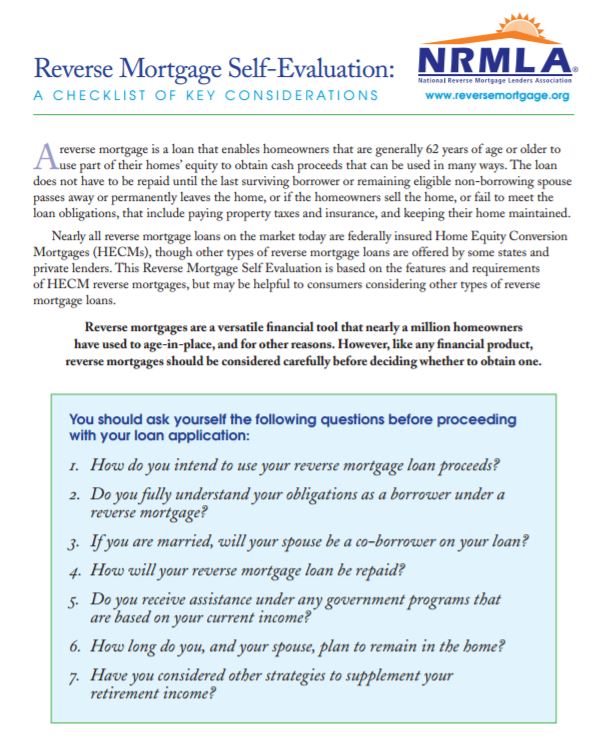
Reverse Mortgage Self-Evaluation: Reverse mortgages are a versatile financial tool that nearly a million homeowners have used to age-in place, and for other reasons. However, like any financial product, reverse mortgages should be considered carefully before deciding whether to obtain one.
Reverse Mortgage Self-Evaluation
Reverse Mortgage Self-EvaluationThe National Reverse Mortgage Lenders Association’s free Reverse Mortgage Self-Evaluation poses seven questions and important considerations interested consumers should ask themselves, and think about, before proceeding with a loan application.

The six-page Reverse Mortgage Self-Evaluation: A Checklist of Key Considerations was created to help senior homeowners consider whether a reverse mortgage is right for them. This guide is best shared during the pre-application phase so that consumers can discuss any questions with their HUD-approved reverse mortgage counselor.

The Self-Evaluation is also posted on NRMLA’s consumer education website at www.reversemortgage.org/Checklist.

The seven questions below, plus additional considerations and information about reverse mortgage loans, are included in NRMLA’s Reverse Mortgage Self-Evaluation.Download and print a free copy of the Checklist here.

1. How do you intend to use your reverse mortgage loan proceeds?

One of the advantages of a reverse mortgage loan is that borrowers generally have the freedom to use their cash proceeds any way they choose. Eligible homeowners obtain reverse mortgages for many reasons.

Reverse mortgage loans are most successful when borrowers have a plan to ensure the money supports and sustains them for as long as they want to stay in their home. Additional consumer protections were put into place in 2013 to help borrowers preserve more of their home equity during the first year of the loan.

  • Do you have a plan for making your reverse mortgage loan proceeds last?

2. Do you fully understand your obligations as a borrower under a reverse mortgage?
Reverse mortgage borrowers are not required to make monthly loan payments to their lender, but must continue to meet certain obligations in order to stay current on the loan. Failure to meet these obligations may result in the loan becoming due and payable.

  • Will you live in your home for the majority of the calendar year?
  • Are you prepared to maintain the condition of your property?
  • Will you be able to pay your property taxes, insurance, and homeowner fees?
  • Do you understand what will happen if you cannot pay your taxes, insurance, or homeowner fees?
  • Do you understand your personal finances will be reviewed?

3. If you are married, will your spouse be a co-borrower on your loan?
Under the rules of a HECM reverse mortgage, borrowers must be at least 62 years old, named on the title of the home, and use the home as their principal residence. Spouses who do not meet these criteria cannot sign the HECM reverse mortgage loan documents as a borrower and will be identified as either an eligible non-borrowing spouse or an ineligible non-borrowing spouse depending on certain additional criteria. You should speak to your HUD-approved reverse mortgage counselor about the non-borrowing spouse criteria.   

  • What if your co-borrower spouse survives you?
  • What if your eligible non-borrowing spouse survives you?
  • What if your ineligible non-borrowing spouse survives you?

4. How will your reverse mortgage loan be repaid?
A reverse mortgage is a non-recourse loan which means that the borrower or the borrower’s estate will never be obligated to pay the lender more than the loan balance or the current value of the home, whichever is less. When a loan is called due and payable, the reverse mortgage borrower or the borrower’s estate only needs to repay the lesser of either the loan balance or 95% of the home’s appraised value at that time. 

  • Do you know your options for repaying the loan?
  • Do you want someone to inherit your home after you pass away?
  • Did you know that you can prepay your reverse mortgage loan?

5. Do you receive assistance under any government programs that are based on your current income? 
A reverse mortgage does not affect regular Social Security or Medicare benefits. However, if you are on Medicaid or receive Supplemental Security Income (SSI), reverse mortgage proceeds may affect your benefits.

  • Are you considering a lump sum cash draw?

6. How long do you, and your spouse, plan to remain in the home?
Reverse mortgages, like many financial products, have costs associated with them, including some that need to be paid up-front when the reverse mortgage is obtained. Among other things, that means that if you or your spouse are not likely to continue to live in your home for more than several years after the reverse mortgage is obtained, you should pay particular attention to those costs and consider them carefully with your HUD-approved reverse mortgage counselor and whether there may be other more cost effective alternative strategies.

7. Have you considered other strategies to supplement your retirement income?

  • Do you qualify for public or private benefits available to low-income people with Medicare?
  • Did you know there are other ways to tap your home equity?
Filed Under: Blog, Colorado Reverse Mortgages Tagged With: Colorado Springs reverse mortgage, Denver Reverse Mortgages, good Fort Collins reverse mortgage, Pueblo Reverse Mortgage

December 16, 2014 by jazzsocialmedia

Bankrate: Can you use a Colorado reverse mortgage to buy a home?

Over the years, celebrities such as Robert Wagner, Alex Trebek and Fred Thompson have touted reverse mortgages as a way to supplement a senior’s fixed income by tapping equity that has accrued in their home. But here’s another, less common use of reverse mortgages that these celebrities may not have mentioned in their commercials: buying a new home. And in some cases, seniors can still hold on to their old homes, too.

In 2009, the Federal Housing Administration introduced a new product called the Home Equity Conversion Mortgage for Purchase, or HECM, that allows older Americans to buy a new home by putting a reverse mortgage on it. So far, the product has been little used.

From October 2013 through June 2014, 40,512 reverse mortgages were originated, according to the FHA. But only 3.3 percent of those were used to buy another home.

“It’s new and just catching on,” says Peter Bell, president and CEO of the National Reverse Mortgage Lenders Association. “I recommend to all seniors that if they are age-eligible and considering purchasing a home, they should at least look at the option.”

Who can use a reverse mortgage?

A reverse mortgage is a type of mortgage in which a homeowner can borrow money against the value of his or her home. No repayment of the mortgage (principal or interest) is required until the borrower dies or the home is sold.

But reverse mortgages aren’t for everyone. In fact, they were specifically designed for older Americans whose net worth was tied up in the homes they already owned. Seniors can use a reverse mortgage to purchase a new home, too, while keeping their existing one.

“Some seniors may want to live closer to family but don’t want to give up their original home,” says Maggie O’Connell, reverse mortgage specialist at ReverseMortgageStore.com. “It could work well for snowbirds or those who want to live in a state with no taxes on income or retirement funds.”

Below are some key points you’ll want to know about reverse mortgages before signing up for one.

Borrower requirements under HECM for Purchase to get a reverse mortgage are:

  • The minimum age is 62 years old.
  • Borrowers must own the property outright or have a considerable amount of equity in it.
  • The home must be the borrower’s primary residence.
  • The borrower must be able to pay the home’s property taxes, insurance premiums, homeowner association dues and any other ongoing property costs.
  • The borrower must have no delinquent federal debt.

The property must pass certain requirements, such as meeting all FHA standards and flood requirements.

Types of eligible dwellings under HECM for Purchase:

  • Single-family homes.
  • Two- to four-unit homes with one unit occupied by the borrower.
  • Condominiums approved by the U.S. Department of Housing and Urban Development.
  • FHA-approved double-wide manufactured homes.

Any new construction requires a certificate of occupancy, the reverse mortgage association’s Bell says. Right now, you cannot get reverse mortgages on homes that are to be built by a developer, he says.

Read the rest of the article: http://www.bankrate.com/finance/mortgages/use-reverse-mortgage-to-buy-a-home.aspx#ixzz3M63xvzA8

Filed Under: Blog, Colorado Reverse Mortgages, Retirement Plans Tagged With: Bankrate, Colorado reverse mortgage, Colorado Springs reverse mortgage, Denver Reverse Mortgages, Fort Collins Reverse Mortgage, Pueblo Reverse Mortgage, The Reverse Mortgage Institute of Colorado Springs

December 1, 2014 by jazzsocialmedia

What a senior needs to retire

Filed Under: Blog, Colorado Reverse Mortgages Tagged With: Colorado reverse mortgage, Colorado Springs reverse mortgage, Denver Reverse Mortgages, Pueblo Reverse Mortgage, The Reverse Mortgage Institute of Colorado Springs, what a senior needs to retire

The Mortgage Doctor Radio Show

ABOUT US

The Reverse Mortgage Institute is run by Steve Haney of Provident Lending, known in the front range as The Mortgage Doctor, from his popular radio show.

The purpose of The Reverse Mortgage Institute is to bring information about the new reverse mortgage to seniors, to give them a choice about how they live their retirement.

PRIVACY POLICY

Website by JazzSocialMedia

© Copyright 2015, The Reverse Mortgage Institute

Provident Lending Corp's NMLS #: 229099
Steve Haney's NMLS #: 229020
Steve Haney's State License #: 100017813

Regulated by the Division of Real Estate

Disclosure:
These materials are not from the U.S. Department of Housing and Urban Development (HUD) or FHA and have not been approved by HUD or a government agency.

The Reverse Mortgage Institute can only originate loans in the state of Colorado.

Search Our Site

Contact Us

The Reverse Mortgage Institute
6025 Erin Park Dr. Ste. C
Colorado Springs, CO 80918
Click to call toll free: (877) 854-1720
Click to call locally: (719) 434-3919
Click to email: [email protected]

Follow RMI

Copyright © 2018 — The Reverse Mortgage Institute • All rights reserved.